
Colorful Alternatives to Barre Chords for Rhythm Guitarists

How about chords with a different sound....
These chords might break your fingers...
but they sound great.....
I’m excited to show you some really cool alternatives to using barre chords. These are simple major and minor chords in theory, but the fingerings are a bit unconventional. Once you get the hang of them, they’ll add some truly colorful sounds to your playing — and the best part is, we’re only working with three strings.
The Concept
For these chords, we’ll be playing on:
- The 6th string (low E)
- The 4th string (D)
- The 3rd string (G)
We’ll be skipping over the 5th string (A). Here’s how you mute that 5th string properly:
Whichever finger you place on the 6th string should slightly lean over and touch the 5th string to mute it. When you strum, your pick will glide over four strings, but you’ll only hear the three that are fretted because the 5th string is muted. Don’t worry about a small click or thud — the volume of the actual notes will overpower that, making it inaudible.

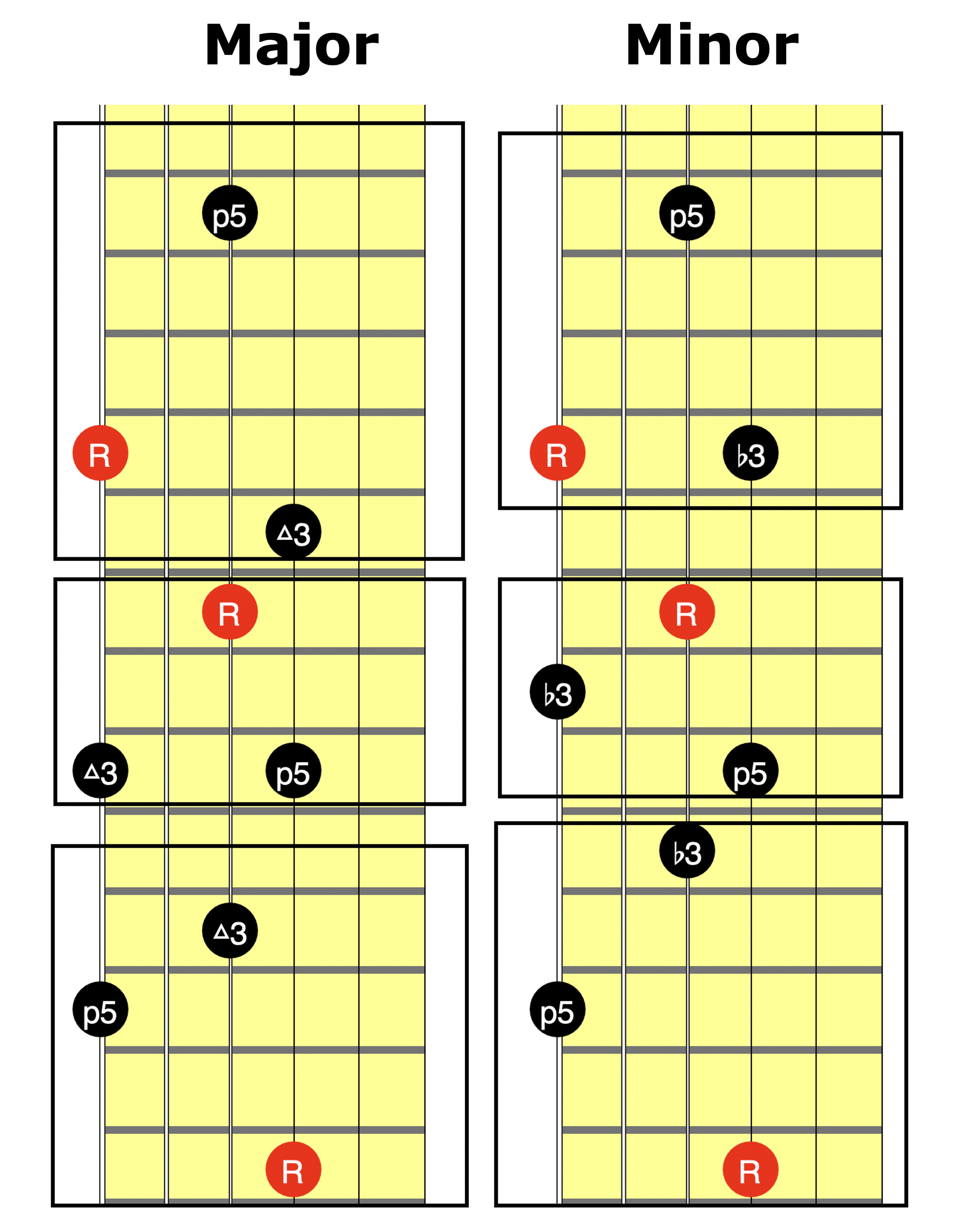
The Chord Shapes
- The Major shapes are on the left
- The Minor shapes are on the right
Red circles (R) represent the root note, black circles indicate intervals:
p5 = perfect fifth, Δ3 = major third, ♭3 = minor third
- C Major Chord
- Shape: Top diagram from the major column
- Root: 6th string, 8th fret
- The shape is built around the root note on the 8th fret, making this a C major chord.
- G Major Chord
- Shape: Middle diagram from the major column
- Root: 4th string (D string)
- Position: Between the 5th and 7th frets
- This gives us a G major chord.
- A Minor Chord
- Shape: Top diagram from the minor column
- Root: 6th string, 5th fret
- Position: Between the 2nd and 5th frets
- This gives us an A minor chord.
- F Major Chord
- From the A minor shape, simply move your first finger (on the 2nd fret of the D string) up one fret.
- Shape: Middle diagram from the major column
- This gives us an F major chord.
Why These Chords Sound Cool
Some of you might be familiar with chord inversions, where the root note isn’t the lowest pitch in the chord. Some of these shapes do start with the root as the bass note, but since we’re skipping the 5th string, the next note of the chord jumps up in pitch. This creates a wider interval between notes, which gives these chords their unique and colorful sound.
While a few of these shapes can feel tricky at first, they’re not total finger breakers. With practice, they become comfortable and can add new textures and colors to your rhythm guitar playing — a fantastic alternative to traditional barre chords!
Remember to always have fun with your guitar and I’ll see you next time…
If you are looking to learn another excellent rhythm guitar skill, you can check out my FREE lesson on how to weave lead guitar melody lines to your rhythm guitar playing here: https://rhythmguitarlessons.net/Pro
Have you ever heard extra notes played between chords and wondered, "Why do THESE notes sound good?" or, "How can I do that?".
Most guitar players struggle to find the right notes to play between chords to make their songs sound better.
The fact is, it's easy to do once you learn how. And the result is your guitar playing sounds much more complex than it is...
This is good news for you:
I've created a brand new eGuide (yes, it's free), where I show you an easy way to connect chords with single-note melodies to sound like a pro.
The best part is it's 100% FREE (no strings attached)!
Download your copy instantly so you can instantly make your rhythm guitar playing sound better. https://rhythmguitarlessons.net/Pro
About Mark Turko: Mark Turko is a professional guitar player and instructor with over 30 years of experience and teaches guitar lessons online.

About Mark Turko: Mark Turko is a professional guitar player and instructor with over 30 years of experience and teaches guitar lessons online.